Bristol Cars
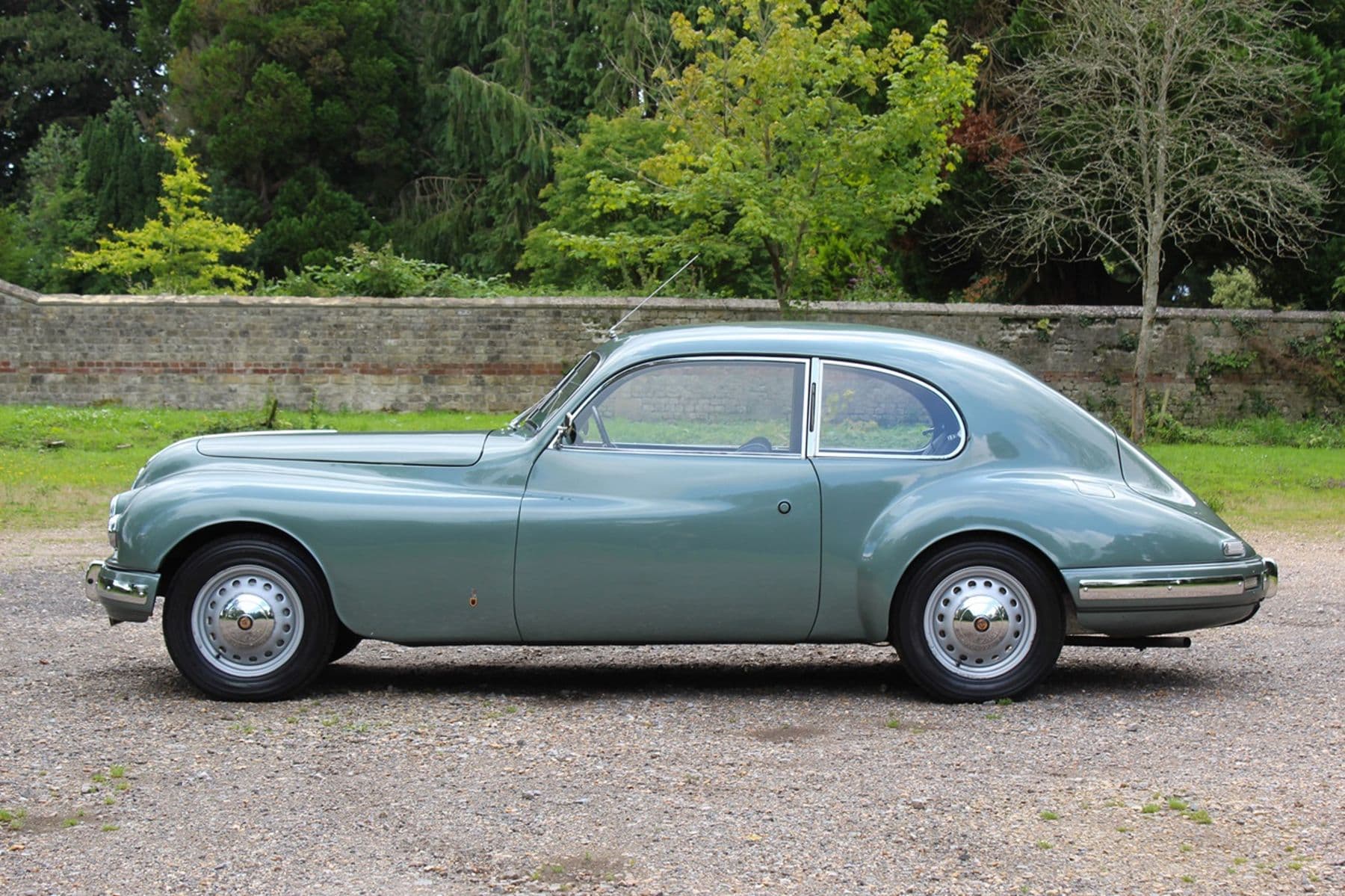
A Bristol 401 saloon photographed in profile
Bristol heritage

1948 · The first cars

The Bristol 401, 402 and 403

Wind-tunnel honed, all aluminium.

The 401 gave the Bristol chassis an ultra-low-drag aluminium body and took the marque around the world, with the 402 drophead and the 403 following on the same lines.

The 401 of 1948 put a wind-tunnel-shaped, aluminium-skinned body on the chassis of the 400 and carried the marque around the world. The 402 drophead of 1949 and the 403 of 1953 followed on the same lines.

Where the 400 had carried a body of largely pre-war form, the 401 was shaped in Bristol's wind tunnel and skinned entirely in aluminium over a light tubular frame, a method the works learnt from the Milanese coachbuilder Touring and then stressed with its own aircraft experience. The result was a roomier car that weighed little more than the 400 and cruised with an ease that made its reputation abroad.

From Touring to Filton

The 401's body began with Carrozzeria Touring of Milan and its Superleggera system, which had grown out of the firm's wartime work building parts of aeroplanes: a framework of small tubes carrying an aluminium skin. Bristol supplied a chassis and Touring built a prototype body, under an agreement later assigned from AFN to Bristol in the spring of 1947. In August 1947 Carlo Anderloni brought one complete and one partly panelled car to Filton and stayed for months to coach Bristol's staff in the method.

The production body was Bristol's own. Touring's handmade sections gave way to metal pressings located on a jig and welded to the 400-type chassis, with Superleggera tube connecting pressing to pressing and carrying an aluminium skin of varying thickness, the whole structure stressed using the company's aviation experience. The shape was worked out on a wooden former with warmed Plasticine applied for every proposed change, and almost everyone from the parent Board down, Sir Stanley White included, had a say. The prototype, LHU 613, was shown at Earls Court and described in The Autocar in November 1948.

A car for long distances

The 401 was much roomier than the 400, yet its body weighed only 120 lb more. It brought Bristol's first purpose-designed heating system and an unusual set of conveniences: pull-knobs inside the car released the bonnet, boot and fuel filler flap, a push-button released the spare wheel, and press-button door locks made the car so secure that, Tony Crook recalled, one buyer locked himself out in the middle of a demonstration.

Pomeroy, writing in 1950, rated the 401's combination of virtues unequalled in any car in the world: four seats, a very large luggage capacity and the ability to cruise fast for hours. Owners abroad put that to the test. Jack Lawson drove a left-hand-drive 401 across Canada in 1951 and took the same car over Peru's Ticlio Pass, at 15,895 ft, in 1954. In Australia the Sydney architect Donald Maclurcan drove his 401 some 3,000 miles a month on the Snowy Mountains hydro-electric project and kept up a long technical correspondence with Filton, which thanked him for helping other owners.

The 402 drophead

The 402 was the drophead 401, built in 1949 and 1950. It followed a visit to Filton in 1948 by Kjell Qvale, later the founder of British Motor Car Distributors, and was conceived as a two-to-four-seater expressly intended for California; in the event only one car was sent out and no further American trade followed. The Superleggera tubing was extended forward of the boot to house the folded hood, and screen pillars of wood composite supported the hood without a top frame. Only twenty-two were made. Tony Crook sold a pair to the actor Stewart Granger and Jean Simmons, his co-star and, from 1950, his wife.

The 403 of 1953

Announced in May 1953 with the same body, the 403 refined what lay beneath it. Its 100A engine, with larger valves and the better breathing and combustion learnt in racing, gave 15 bhp more at no gain in weight. Heating and demisting were improved, the brake linkage was redesigned with Alfin drums at the front, and an anti-roll bar tamed the 401's slight tendency to oversteer at speed. The rear axle gained taper-roller pinion bearings, a stronger casing and a redesigned half-shaft end. The 403 wore its badge on red rather than yellow.

It was a car for crossing countries. In August 1954 the 403 RHU 999 carried the Lord Mayor of Bristol's greetings to Bordeaux for the anniversary of that city's liberation, four up with heavy cameras, and the same car once ran from Bristol to Paris in 5 hours 5 minutes, including the 35-minute Silver City air ferry from Lympne to Le Touquet.

In competition

The 2-litre Bristols earned their reputation in competition. A 400 driven by Zdenek Treybal and Dobry had finished third overall in the 1949 Monte Carlo Rally, and the 401 carried on the work. In October 1950 Tony Crook took a demonstration 401, standard apart from larger racing tyres and a higher axle ratio, to Montlhéry and covered what is recorded as the greatest distance in an hour ever achieved by a 2-litre saloon. Crook's 401 was first in class when Bristols won the team award at the 1952 Silverstone production touring car race. Bill Banks and Michael Porter led the 1953 Tulip Rally on the road in Banks's 401, only to be placed second in committee, and in 1955 Banks's 401 finished third overall in the Tulip. After 1955 Bristol's models were less suited to rallying, and that era closed.

Working lives

Many 401s remain in use today, some in single ownership for decades, which is the surest measure of how the cars were made. One has covered 250,000 miles in a single ownership of 46 years. Australian owners credited the tubular-steel body frame of the 401 and 403 with standing up to rough roads, and one called them the finest cars ever imported into the country.

Published figures

Figures as recorded in period and historical sources, reproduced as quoted rather than as tested figures.

401402403
Introduced1948 (prototype shown at Earls Court)1949May 1953
Bodytubular frame with aluminium skin on the 400-type chassisdrophead 401as 401
Engine2-litre six, 85 seriesas 401100A, 100 bhp at 5,000 rpm
Productiontwenty-two
Montlhéry, October 1950, as recorded104.78 miles in one hour, best lap 107.55 mph (Tony Crook, demonstration 401)

Lineage and related pages

Sources. Bristol Cars Group heritage research from period and historical published sources; approved page copy, Bristol Cars Group. Figures quoted are Bristol Cars Ltd’s own published claims of the time and have not been independently tested by Bristol Cars Group Ltd.

Price new

What it cost new

What the 401, 402 and 403 cost new. Until 1973 British car prices were a basic price plus purchase tax, and the rate changed often. Prices here include purchase tax unless marked basic.

Bristol 401 · about 1950

£1,925 basic[1][2][3]

Basic price, before purchase tax, on an undated page of about 1950.

Priced against: Bristol 401, about 1950
CarPrice
Bristol 401£1,925 basic
Jaguar Mk V£988 basic
Aston Martin DB2£1,498 basic
Lagonda£1,750 basic

Basic prices, Earls Court show list, October 1950; the Jaguar from Grace's Guide's page of the same period

Bristol 401 · January 1953

£3,112 12s 3d[4]

Including purchase tax; £2,000 basic. Motor Sport's road test.

Bristol 402 · 1949

As the 401[5]

The drophead was sold at the same price as the saloon.

Bristol 403 · 1953

£2,976 2s 6d[6][7][8]

Including purchase tax, after the rate fell to 50% in 1953.

Archive plates

A Bristol 401 saloon in profile