Bristol Cars
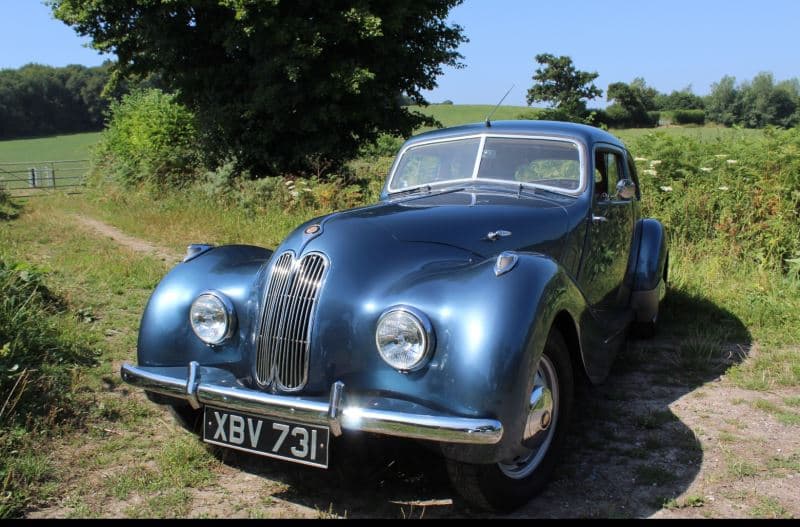
A Bristol 400 photographed from the front three-quarter angle
Bristol heritage

1946 · The beginning

The Bristol 400, 1946 to 1950

The first Bristol motor car.

The 400 established the principles that would define the marque: aircraft-informed construction, discreet performance and a refusal to build for the mass market.

The 400 was the first Bristol, built at Filton from 1946 to 1950 by the Car Division of the Bristol Aeroplane Company. It carried a BMW-derived 2-litre six, an aircraft-standard body and the principles that defined every Bristol after it: aircraft-informed construction, discreet performance and a refusal to build for the mass market.

Why an aircraft company built a car

The Bristol Aeroplane Company had been here before. After the Armistice of 1918, with orders cancelled within a fortnight and thousands of employees idle, it had built a light car, the Bristol Monocar, and bodies for Armstrong Siddeley and for the buses of its sister company, Bristol Tramways. When the Second World War began, Sir G. Stanley White, managing director since 1911, was determined not to be caught the same way. As early as 1941 his son George S. M. White wrote or commissioned papers proposing a post-war car division. Alvis, Aston Martin, Lagonda, ERA and Lea-Francis were all considered as companies to buy.

The answer came by chance in May 1945, in a conversation between D. A. Aldington, a director of Frazer Nash then serving as a Ministry of Aircraft Production inspector, and Eric Storey, an assistant to George White. Frazer Nash was taken over by the Aeroplane Company almost at once. The Aldington brothers had sold the Frazer Nash BMW before the war and intended to build an updated version after it; with the support of the War Reparations Board, H. J. Aldington went to Munich and secured the rights to three BMW models and the 328 engine. George White and Reginald Verdon-Smith joined the Frazer Nash board. In January 1947, soon after the first cars had been built, differences between the Aldingtons and Bristol led to the resale of Frazer Nash, and the Bristol Car Division became an independent entity under George White as managing director.

The car

Bristol's own history describes the 400 as "a close-coupled two door saloon inspired by the pre-war 326 and 328 BMWs but benefitting from the metallurgical advances of WW2 aviation". The engine was a 2-litre six built by Bristol to the BMW 328 design, which the company called "unusually efficient for its time". The car's virtues, in the factory's later summary, were low aerodynamic drag, high mechanical efficiency and modest weight, and they made it a successful rally car, with sporting success recorded from the 1948 Polish Rally onwards.

Above all the 400 was built as aircraft were built. The cars of this period, Bristol wrote, were "built to aircraft standards, using aircraft construction methods and under strict aircraft-style quality inspection", and "quickly gained a reputation of being among the finest cars in the world". It set a pattern that endured for decades: compact dimensions, long-distance ability, an unusually complete view from the cabin and engineering decisions made for the owner rather than the fashion of the moment.

When was the 400 announced?

Bristol's own pages have not always agreed. The company's production table of 2010 gives "Type 400 Production: 1946 - 1950", its 2015 and 2018 histories head the entry "1946: Bristol 400", and the marque dates its anniversaries from 1946. Yet in February 2002, announcing the Blenheim 3S, Bristol wrote that "exactly 55 years ago, Bristol's first car, the 400, was announced to critical acclaim", which points to early 1947. The likeliest reading is that the car existed and was being built in 1946 and was formally announced and shown in 1947. Bristol Cars Group dates the marque from 1946, and this page follows that.

Successors

The 400 was succeeded by the aerodynamic 401 in 1948, while 400 production continued to 1950. The two cars overlapped, as the 2010 table shows, and the 401's story is told on its own page.

Published figures

Bristol's own later summaries of the 400, reproduced as the company's statements rather than tested figures.

Bristol 400
Production1946 to 1950 (Bristol's 2010 table)
Bodyclose-coupled two-door saloon
Engine2-litre six-cylinder, BMW 328 design, Bristol-built
Top speed, as quoted by Bristol95.7 mph (Bristol's histories of 2015 and 2018)
CompetitionPolish Rally 1948 onwards

Lineage and related pages

Sources. Bristol Cars Ltd website, bristolcars.co.uk, as archived: History (1999, 2010), Blenheim 3S announcement (2002), "Bristol Cars History" (2015), Heritage (2018). Figures quoted are Bristol Cars Ltd’s own published claims of the time and have not been independently tested by Bristol Cars Group Ltd.

Price new

What it cost new

What a new 400 cost, set against the cars a buyer might have chosen instead, priced in the same list. Until 1973 British car prices were a basic price plus purchase tax, and the rate changed often. Prices here include purchase tax unless marked basic.

Bristol 400 · March 1947

£1,853[1]

Saloon, including purchase tax. Motor Sport's buyer's list.

Priced against: Bristol 400, March 1947
CarPrice
Bristol 400£1,853
Jaguar 3½-litre£1,099
Lagonda£1,751
Bentley Mk VI£3,316
Rolls-Royce Silver Wraith£4,249

Same list, including purchase tax

A two-litre Bristol cost two-thirds as much again as Jaguar's biggest saloon, and a little over half a Bentley.

Bristol 400 · October 1949

£2,723 14s[2][3][4]

Including purchase tax, which had doubled on dearer cars in 1947. Earls Court show list.

Priced against: Bristol 400, October 1949
CarPrice
Bristol 400£2,723 14s
Jaguar Mk V£1,263 3s 11d
Aston Martin 2-litre sports coupé£2,331 14s 6d
Lagonda dropheadover £3,420
Frazer Nash Le Mans Replica£3,501 10s

Same show list, including purchase tax; the Jaguar's £988 basic is from that list, with purchase tax as Grace's Guide gives it

Archive plates

Bristol 400

Bristol Cars Approved

A Bristol 400 for sale through SLJ Hackett.

All cars for sale