
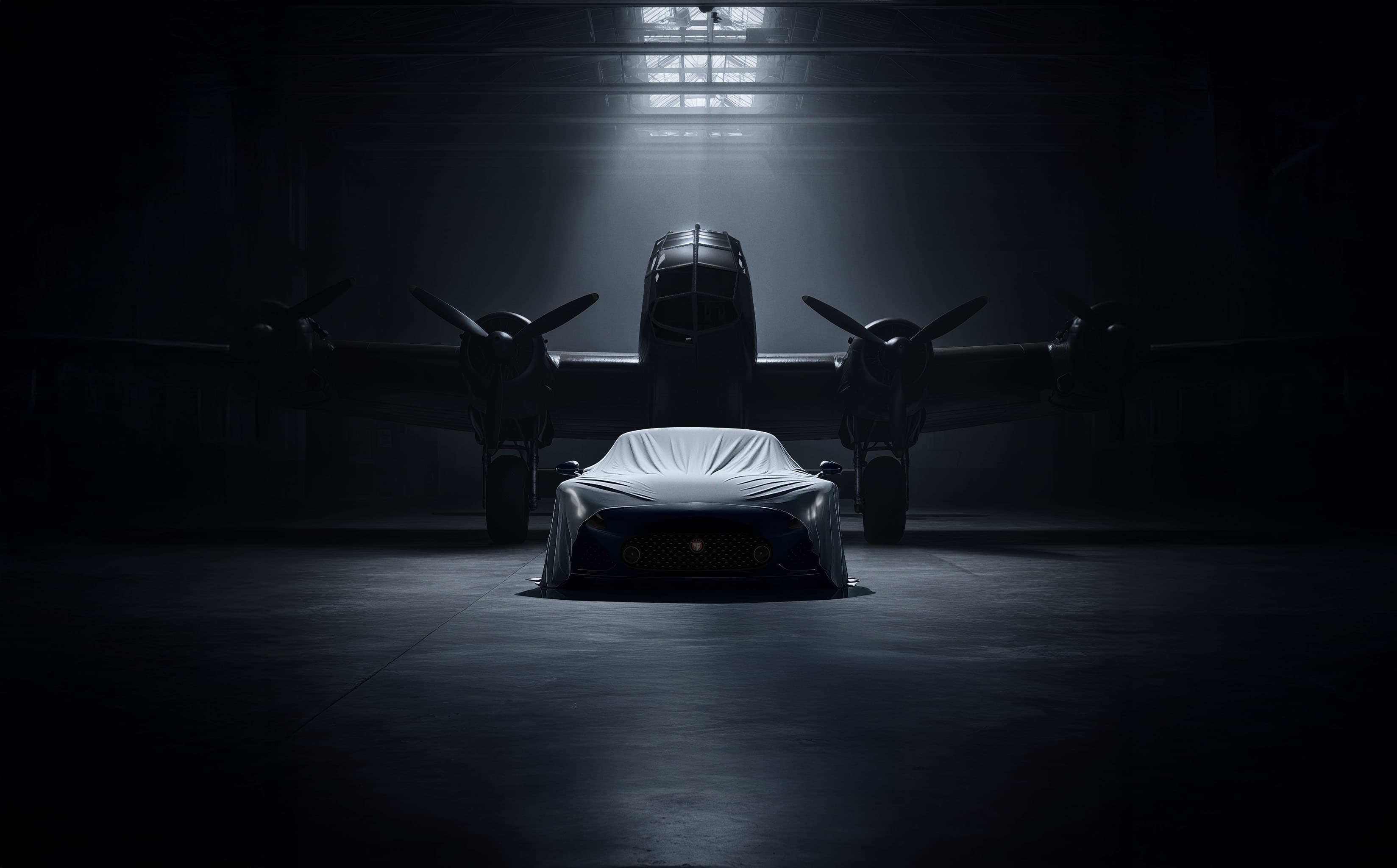
2003 · The open two-seater
The Bristol Blenheim Speedster, 2003
An open Bristol built on Blenheim running gear, from a forgotten prototype.
The Blenheim Speedster was a modern open two-seater built on Blenheim 3 running gear and shown at Kensington in January 2003. It began as a tribute to a forgotten 1950s prototype that factory staff knew as The Bullet, a different car from the Bristol Bullet of 2016.
The Blenheim Speedster was a modern open two-seater built on Blenheim 3 running gear and shown at Kensington in January 2003. It began as a tribute to a forgotten 1950s prototype that factory staff knew as "The Bullet". That prototype has nothing to do with the Bristol Bullet of 2016 apart from the name, and this page keeps the two apart.
The car in the back room
Bristol told the Speedster's origin story in its own words on the launch page, and it is worth repeating as Bristol told it. Most manufacturers, the company wrote, build and test secret prototypes that never reach production and then scrap them. A rare exception occurred when a senior member of staff at the Filton factory suggested a look at an abandoned car in a back room. "Layers of dust and blankets hid an extraordinary streamlined 2-seater with prominent aerodynamic fins."
The car was believed to have originated as a proposed replacement for the Arnolt-Bristol of the early 1950s, with a Bristol 2-litre engine, and to have been tested later with a Chrysler V8 and an experimental fuel-injection system. Bristol's view, looking back, was that it had "hit on much the same formula as the later AC Cobra but considered it too 'raw' for their gentleman clientele", and had chosen instead to concentrate on the V8 407 saloon of 1961, which laid the foundation for the next generation of Bristols. The prototype lived on as a factory test-bed for rebuilt engines and gearboxes until it was parked and forgotten some time in the 1970s. In the late 1990s Bristol personnel restored it fully and, the company wrote, "revealed it was originally known as 'The Bullet', on account of its generous performance".
Bristol offered no dates, chassis details or photographs of the prototype on its website, and none have been recovered from the archive. What the company did say is that the restored car "has since delighted all who have driven it" for its performance, appearance, handling and "surprising creature comforts".
A Speedster for the Jubilee year
With the Queen's Golden Jubilee in 2002 and "a general nostalgia for the 1950's", the factory built an updated interpretation of the prototype on modern Blenheim components, "just for the fun of it". The result, Bristol wrote, "surpassed all our expectations", and the company agreed to build "a short run of 12-15 cars" to be known as the Blenheim Speedster.
The Speedster used the Blenheim 3's chassis and drivetrain: the 5.9-litre V8 with a quoted 390 lb ft of torque, the four-speed automatic, the 2.88:1 final drive (3.06 optional) and the Bristol eight-link rear axle. Styling was "a subtly enhanced version of the original" prototype; the interior was new and trimmed to Bristol's usual standard. Bristol quoted a kerb weight of 1,395 kg, described as a saving of "some 350 kg" against the saloon. Twin race-type fillers fed a large tank intended, with the "huge and impeccably trimmed luggage boot", for what Bristol called intercontinental range: "just the thing for a weekend trip to Italy!"
The car rode on 17-inch five-spoke wheels with 255-section tyres front and rear, with firmer but, Bristol insisted, still comfortable suspension settings. The 2003 page was headed "On view now" and invited orders at a base price of £127,000 (£149,225 with VAT).
What the Speedster was for
Bristol was candid that the Speedster was not part of its long-term plan, which remained "exceptionally well engineered and characterful four-seaters along with a very small number of ultra-modern high performance 2-seaters (i.e. Fighter)". It was, in the company's words, a stunning tribute to Bristol's early aircraft-based style combined with modern comfort and performance, filling "a temporary place in our range".
Planned run and actual numbers
Bristol's 2003 page committed to 12 to 15 cars. By 2008 the same page had been rewritten: the Speedster was now "a limited production car to special order" and "built to special order only", and the sentence about 12 to 15 cars had gone. The 2008 text also revised the weight saving to "some 250 kg" while leaving the kerb weight at 1,395 kg; Bristol gave no explanation and this page does not choose between the two figures. Bristol's 2010 production table listed "Speedster/Roadster Production: 2003-current".
No production total for the Speedster appears anywhere in Bristol's archive. Bristol Cars Group will publish a figure when it can be confirmed from factory records rather than repeat estimates.
Published specification
Bristol's figures for the Speedster as published in 2003 and 2008, reproduced as attributed factory claims.
| Blenheim Speedster | |
|---|---|
| Engine | 5,900 cc V8, 101.6 x 90.93 mm, 9.25:1; maximum torque 390 lb ft |
| Transmission | 4-speed automatic, 2.19:1 stall converter with lock-up; final drive 2.88:1 (3.06 optional); 40.72 mph per 1,000 rpm |
| Suspension | Blenheim: unequal-length wishbones and coil springs front; 8-link axle with torsion springs rear; adjustable dampers; limited-slip differential |
| Steering | power-assisted recirculating ball; 14 in wheel, leather or wood rim |
| Brakes | self-adjusting discs, 4-piston front, 2-piston rear |
| Wheels and tyres | 8 x 17 in five-spoke alloy; 255/55 x 17; full-size spare in front wing |
| Fuel fillers | twin lockable aircraft-type flush fillers on the rear body |
| Length, width, height | 4.674 m, 1.752 m, 1.118 m |
| Wheelbase and track | 2.89 m; 1.422 m front, 1.435 m rear |
| Turning circle | 11.912 m |
| Kerb weight | 1,395 kg |
| Performance, as claimed by Bristol | 0 to 60 mph "in around 5 secs"; "a top speed approaching 160mph" |
| Base price (UK, ex VAT) | £127,000 (2003) |
The fuel-tank capacity is omitted: Bristol's page gave "165 litres (30 Imp. gallons)", two figures that do not agree with each other (30 imperial gallons is about 136 litres), and the body text said "a special 30 gallon fuel tank". Either number could be the intended one.
Lineage and related pages
Sources. Bristol Cars Ltd website, bristolcars.co.uk, as archived: Blenheim Speedster (captured 10 January 2003 and 20 September 2008); History page with production table (2010); "Bristol Cars History" (2015). Independent contemporary report: PistonHeads, "Blenheim Speedster", 6 January 2003. Figures quoted are Bristol Cars Ltd’s own published claims of the time and have not been independently tested by Bristol Cars Group Ltd.