Bristol 406 · August 1958
£4,493 17s[1]
Including purchase tax, as announced. The Times headlined it "New Bristol Car For £4,493".

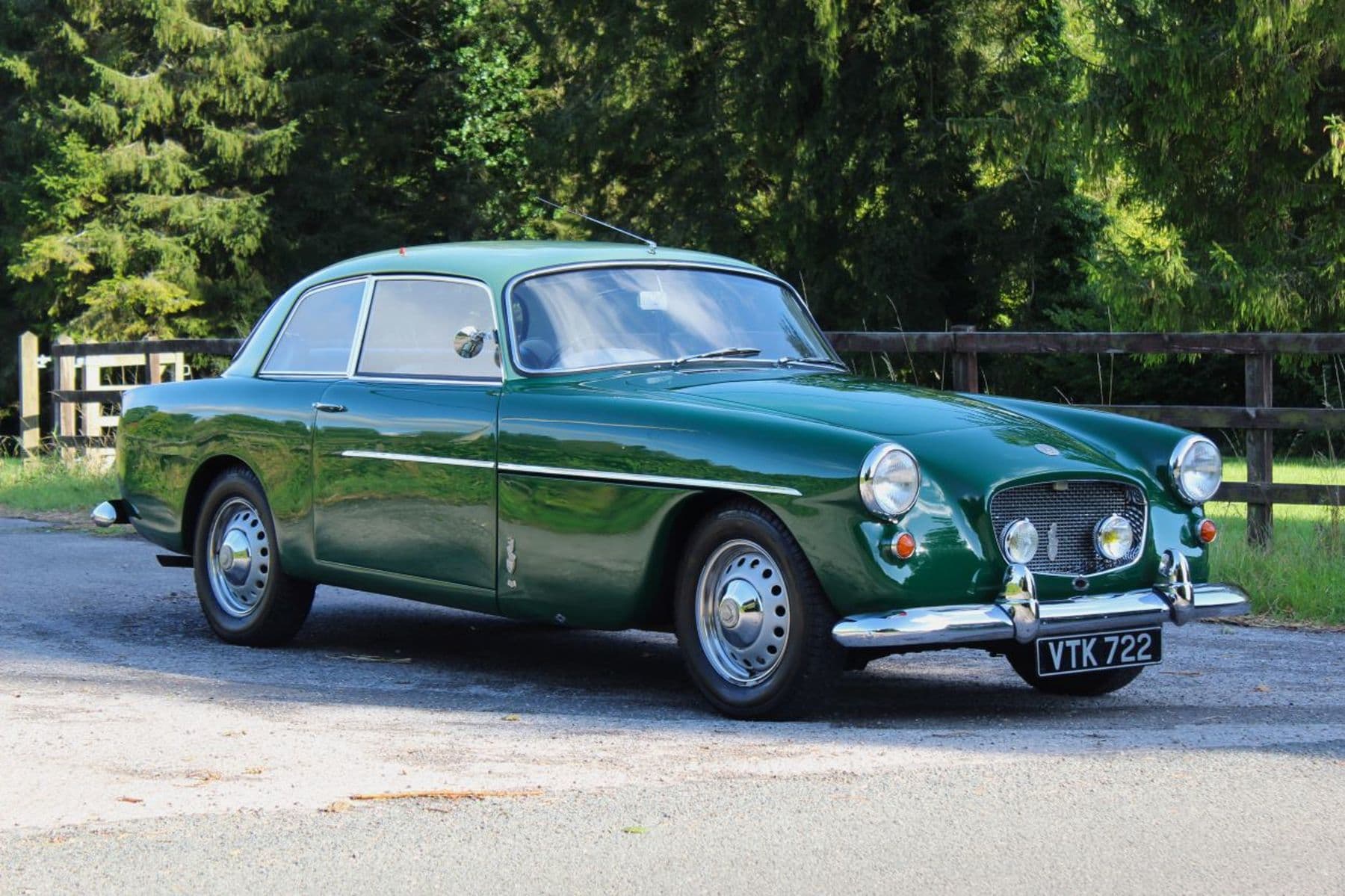
1958 · The gentleman’s express
The last of the six-cylinder Bristols.
The 406 closed the six-cylinder era with its engine enlarged for torque and disc brakes on all four wheels, among the first of any marque.
The 406 was the last Bristol with the marque's own six-cylinder engine and the first with disc brakes on all four wheels. It also carried the company through 1960, when its parent group decided to close it and George White bought it instead.
The 406 was the last Bristol to carry the marque's own six-cylinder engine, enlarged to 2.2 litres for torque rather than outright power. It was the first Bristol with disc brakes on all four wheels, a Watt linkage to locate the rear axle and a body developed with the aeroplane company's wind tunnel. Bodies were built by Jones Brothers of Willesden on a steel inner frame with aluminium outer panels, then finished, trimmed and painted at Filton.
Two short-chassis 406 S cars were built; one of them covered some six hundred thousand miles, first with Tony Crook and then with an Aberdeen vet. A small run of 406 chassis went to Zagato in Milan for lighter two-seater coupé bodies.
The 2.2-litre engine was made by enlarging the bores of the existing 2-litre to take larger pistons. A twin-SU installation was tried and found inferior to the three Solex carburettors. After the Earls Court show a piston seizure was traced to bore distortion between the Siamese cylinders; the cure was to bore out the block, fit liners and revise the compression and oil-control rings.
The A-bracket that had located the rear axle since the 400 gave way to a Watt linkage, its rocking lever pivoted on the back of the differential casing, and Bristol adopted a bought-out Salisbury hypoid axle. Dunlop disc brakes on all four wheels put Bristol among the first car makers to adopt discs, and ended the brake-fade complaints of the early cars. The handbrake had its own pads, adjustable with a screwdriver through holes in the rear wheels. Unlike the rivals it was compared with in 1959 and 1960, the 406 was not offered with an automatic gearbox.
A model of the 406 was tested in the aircraft company's wind tunnel. Bristol also looked outside: a body by Beutler of Thun on the 2.2 chassis was shown at the 1957 Paris Salon and at Earls Court, flown from Geneva to London in a Bristol Freighter, but neither George White nor Tony Crook liked it. The first Filton-designed prototype was completed in 1957, and the definitive production car, 406 BHU, was described in The Motor in August 1958.
It had two doors, thin-framed windows, no conventional upper door pillar and a boot lid that rose nearly to the vertical. Its grille began as a brougham-style arrangement of iron bars, became chromed strips and finally simple wire mesh, to let more air through.
Jones Brothers' bodies used a simple but strong inner framework of steel panels, with aluminium outer panels formed on Bristol's own body buck. At Filton the chief inspector, Harold Reeves, had such a reputation that a factory wag said nothing ever got past him. Even the Jones Brothers' ginger cat, which stowed away in a 406 and was found under the bonnet, was lorried home to Willesden as "an approved passenger".
The details were thought through. The front seats had wooden frames, which made it easy to replace the Dunlopillo decades later, and the wash-wipe ran off engine induction depression, giving a second of spray and six seconds of fast wiping, adjustable by a bleed screw. A properly maintained engine kept its full effectiveness for at least 100,000 miles, and the structure outlasted several engines.
The two 406 S cars were between the 404 and the 406 in length. The Filton-bodied car, 406 CHU, did about 100,000 miles with Tony Crook and then some 500,000 more on an Aberdeen vet's rounds; during the sale negotiation there was a sick sheep in its folded rear seats. The second 406 S went to Zagato in Milan for a two-seater coupé body commissioned by Crook, and later belonged to Harry Wareham, chairman of the Bristol Owners' Club from 1987 to 1997.
The 406 Zagato coupé was nearly a foot shorter and lower than the saloon, with a tuned engine, and it sold slowly. A batch of six was built, of which five survived in 2008: two in Britain and one each in Scandinavia, Australia and New Zealand.
From 1959 Bristol Cars was a subsidiary of the newly formed Bristol Siddeley Engines. The group studied a larger car, fitting an Armstrong Siddeley Star Sapphire six into a 406-type chassis that the staff nicknamed The Heap, but notes made before the Bristol Siddeley Board meeting of 19 January 1960 recommended shutting the car business "as quickly as conveniently, and as cheaply as possible". George White was not on that Board. He refused to abandon the employees who had joined him at the start or the owners who relied on the factory's service, and Tony Crook promised to back him. On 9 September 1960 White signed the agreement to buy Bristol Cars, with Crook taking two-fifths of the shares; neither could act on capital, shares or new directors without the other.
White's father, Sir Stanley, was still being driven to work in a dark green 406 in the 1960s. In 1961 the 407 replaced the six with a Chrysler V8.
Figures as recorded in period and historical sources, reproduced as quoted rather than as tested figures.
| 406 | 406 S | 406 Zagato | |
|---|---|---|---|
| Engine | 2,216 cc six (110 unit), 105 bhp | not stated | tuned 2.2, 130 bhp |
| Brakes | Dunlop discs on all four wheels | as 406 | as 406 |
| Rear axle location | Watt linkage; Salisbury hypoid axle | as 406 | as 406 |
| Body | Jones Brothers, steel inner frame and aluminium panels | shorter chassis; one Filton body, one Zagato | Zagato two-seater coupé, nearly a foot shorter and lower than the saloon |
| Built | two | a batch of six |
Lineage and related pages
Sources. Bristol Cars Group heritage research from period and historical published sources; approved page copy, Bristol Cars Group. Figures quoted are Bristol Cars Ltd’s own published claims of the time and have not been independently tested by Bristol Cars Group Ltd.
Price new
What the 406 and the 406 Zagato cost new, set against the cars on the same Earls Court show lists. Until 1973 British car prices were a basic price plus purchase tax, and the rate changed often. Prices here include purchase tax unless marked basic.
Bristol 406 · August 1958
£4,493 17s[1]
Including purchase tax, as announced. The Times headlined it "New Bristol Car For £4,493".
Bristol 406 · October 1959
£4,244[2][3]
After the purchase-tax cut of April 1959. Earls Court show list.
| Car | Price |
|---|---|
| Bristol 406 | £4,244 |
| Aston Martin DB4 | £3,755 |
| Aston Martin DB4GT | £4,534 |
| Facel Vega HK500 | £4,534 |
| Alvis TD21 | £2,827 |
| Jaguar Mk IX | £1,884 |
| Mercedes-Benz 300SL | £5,314 |
| Bentley S2 | £5,661 |
| Rolls-Royce Silver Cloud II | £5,802 |
Same show list
A 406 cost £489 more than a DB4, more than two Jaguar Mk IXs, and about three-quarters of a Silver Cloud.
Bristol 406 Zagato · October 1960
£4,792[4][5]
The lighter Zagato-bodied 406; the standard 406 was £4,244 on the same list.
| Car | Price |
|---|---|
| Bristol 406 Zagato | £4,792 |
| Jaguar Mk IX | £1,881 |
| Aston Martin DB4 | £3,968 |
| Facel Vega HK500 | £4,740 |
| Maserati 3500GT | £5,852 |
| Bentley S2 | £5,944 |
| Rolls-Royce Silver Cloud II | £6,092 |
| Ferrari 250GT | £6,326 |
Same show lists
Sources
Archive plates
Bristol Cars Approved
